
Literate Dublin QR Graffiti
Functioning codes, verified.
#

Life Work

author: Donald Hall
name: Paul
average rating: 4.40
book published: 1993
rating: 3
read at: 2012/05/07
date added: 2012/05/08
shelves: memoir, non-fiction
review:
Let’s assume you were wondering if there was ever a market for blogging before the semi-coherent daily ramble became a legitimate form of communication ten or twelve years ago. To confirm this, you need look no further than Donald Hall‘s Life Work, a semi-topical serialized set of quasi-daily ruminations on the subject of work, self, life, death, family, history and the intersections of all the above. Written in the very early nineties, this book is a blog, regardless of whatever memoir title might be attached to it. The short essay formatting, the tangental discussions on a broad central theme; the only things missing are ironic hyperlinks and the occasional “sorry I haven’t posted in a while, I’ll be better soon, I promise!” entires.
I was assigned Life Work as a part of an English course I took during one of my failed attempts at college. This would be back in like 1996, when the web was just starting to be ubiquitous and when the notion of an online life was still mostly science fiction. In that time, which sounds quaint to describe and depresses me greatly to think of a time less than twenty years ago as such, the notion of a person spending an hour or more a day on actual post mail as opposed to email or Twitter or whatever was still current enough to not seem strange. Reading the book now, it kind of boggles my mind to know that something so central to communication when I was not even just a small child but a teenager, a near-adult, has all but been antiquated. Hall describes his work, his idealized day involving the anticipation of a day spent working on poems and essays and letters and books, then relaxing with his wife and attending to various chores come evening. He describes the workdays of his parents, his grandparents and great-grandparents. He talks about work in a general sense, he talks about it in great detail.
You can tell that Hall is a poet; his prose and essay stylings are peppered with dips into lyrical rhapsodies. He’s also kind of hard to like sometimes: he is stuffy and pretentious one moment and then grounded and rootsy the next. I kind of liked that he manages to convey the complexity of a real person by preserving the daily shift in tone and mood, in refusing the temptation to not edit down or smooth over these transitory notes. Still, there are a lot of points where Hall’s topic of work, as presented in this proto-blog format, become a kind of slushy non-thesis, weighed down by specifics that I don’t think anyone asked for.
Partway through the book, Hall deals with a health crisis, which puts a new spin on the topic (and a welcome one, though saying so sounds absolutely terrible I know), propelling the end of the book through with a renewed urgency that adds a nice edge to the languid tone of the first half. I did like that Hall kind of sold me (as if I needed selling) on the quiet life of the comfortable country writer; his depictions of an unhurried New England life ignited both my aspirational drive as well as some wanderlust to explore the semi-rural areas of Vermont and New Hampshire he creates in mental landscapes. Perhaps these places don’t or never did exist, but I’d like to go and see for myself.
And maybe, then, this is the final success of the book. In a collection of meandering essays about living and working, Hall has made me interested in doing both, doing more with each, and finding a happier junction where the two—inevitably, as Hall believes—meet.
The Host (2006)
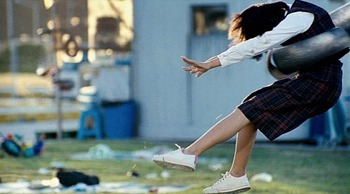 The Host
★★★☆☆
Directed by: Joon-ho Bong
Written by: Joon-ho Bong, Won-jun Ha and Chul-hyun Baek
Rarely do I find myself so torn between star ratings. I refuse to dip into the namby-pamby arena of half-stars, extending my five (or technically six) point scale to ten points just so I can split the difference between “It Was Okay” and “Didn’t Like It.” But let’s just say that while I’m settling on three stars for The Host, it’s really a two and a half star movie, one which I just barely tolerated above dislike but which I also came just short of feeling like I wasn’t sorry I had spent the time to watch it.
The real issue with The Host is that I admire it for trying something different. This is a movie that could have gone a half dozen different directions: Full blown monster horror pic; creepy enviro-action flick; tense suspense drama; political satire/allegory; subversive genre send-up; dark character drama with supernatural framework. Instead of picking one of these paths, The Host picks them all. I respect the moxie of the filmmakers for doing something that is so un-Hollywood (obvious guy says duh, this is a Korean film). However, in dividing the film’s—and the audience’s—time and attention into all these things, we end up with a mishmash of a picture that can’t seem to decide what, if anything, it wants to say.
There are pivot points in the movie where the filmmakers could have selected their vehicle and ridden it to whatever destination lie down that path. But each one is meticulously sidestepped so that we can have key (undeveloped) characters that aren’t introduced until well past the halfway point, a curiously unsatisfactory conclusion, a bizarre character event near the end that seems to have no impact on the protagonist, a lot of pretty rough CG effects and an awful lot of the main characters running around aimlessly for long stretches of the film. There is a metaphor in the characters actions for the writer’s intents, but like the writers themselves, I can’t be bothered to make it work. So my final recommendation is go watch The Host. Or don’t. Really, it doesn’t matter either way.

The Bad Beginning (A Series of Unfortunate Events, #1)

author: Lemony Snicket
name: Paul
average rating: 3.71
book published: 1999
rating: 3
read at: 2012/05/04
date added: 2012/05/06
shelves: childrens, humor, novel
review:
Occasionally my forays into young adult or children’s books turn up gems like The Island Of The Blue Dolphin, which transcend their target audience and manage universal appeal. Then there are those like Lemony Snicket‘s Series Of Unfortunate Events which are clearly, perhaps almost painfully, for kids. This isn’t, I suppose, as harsh of an indictment of The Bad Beginning as it sounds, since it’s only doing what it was designed to do. But the frequent vocabulary lessons—in this case meaning in-prose definitions of words that may not be familiar to young readers—can be pretty distracting for an older audience.
Additionally, this is a wisp of a book in which not terribly much happens: The Baudelaire children—Violent, Klaus and baby Sunny—lose their parents in a fire, are put under the care of their evil uncle, Count Olaf, and try to thwart a plot by Olaf to steal their inheritance. There are a couple of other minor characters here and there, but that’s basically the gist of it. Granted, there are twelve other volumes to the series so between them all I suspect there may be a small handful of more complete novels, but The Bad Beginning seems particularly glib, almost unfinished.
I will say that Snicket surprised me with the resolution of the central conflict and the characters of the children are all likable and egaging. Plus the gentle dark humor strikes a tone that my ten year-old self would have really enjoyed so overall I can say that it was enough to make me think that at some point I might like to finish the whole series. However, they strike me as the kind of books that one might find in a family bookcase while housesitting for some friends or borrowing a cabin and read through in a sitting on a slow weekend afternoon. They don’t feel like something I want to dedicate a lot of time to tracking down and acquiring.

The Handmaid’s Tale

author: Margaret Atwood
name: Paul
average rating: 3.96
book published: 1985
rating: 4
read at: 2012/05/03
date added: 2012/05/04
shelves: novel, science-fiction
review:
The stylistic decision making process in literary fiction interests me. This is probably due to my aspirations of writing, but I think even without that I would find it intriguing to note what the selection process is among those who write as a means to not just convey happening. Literary writers seem to want to convey poetry, rhythm, implication, dynamism and other less tangible elements than might be strictly necessary for storytelling.
I can see why it is done, certainly. I think to one degree or another all writers are trying to use language to convey more than just the meanings of the words, but the line that separates exposition from aesthetic depends on what the writer is choosing to focus on. What pushing off of mere conveyance of ideas toward something more ethereal facilitates, though, is obviously to elevate what might otherwise be a simplistic narrative. For instance, Margaret Atwood in The Handmaid’s Tale: the story within of a dystopian, feminist’s nightmare world where literal biblical interpretations have segmented a society into female objects and male people, is familiar enough in set up. Comparisons to Aldous Huxley‘s Brave New World or George Orwell‘s 1984 are ready and appropriate.
But what Ms. Atwood performs is a feat of linguistic inflation, using her stilted, meandering prose to create more than just a satirical rebuff of modern society. She manages to define a multilayered dissection of gender roles, sexual politics, the passivity of modern first-world disconnection, the role of dissent in structuring societies, moralism (and its associated relativity) and the character archetype of the reluctant survivor.
The Handmaid’s Tale unfolds like a mystery, casting the reader as the detective trying to wade through a frustratingly obtuse narrator’s account of events that are not necessarily unreliable but disjointed and incomplete, especially through the first third of the book. What carries the novel in this early portion is the staccato, thoughts-to-page style of the writing and the curated curiosity that demands at first an answer to “what is going on here?” but rapidly shifts into the far more pertinent, “how did it get this way?” Eventually Atwood does begin to peel back the layers and the protagonist, Offred, recalls the key moments in the societal collapse (it’s worth noting that Atwood or perhaps just her narrator seem to frame the establishment of the fictional setting Gilead as a construction, a building process, when as a reader we can see it as plainly destructive).
Early on what is most fascinating is to see Atwood carefully constructing her sentences in fragments, tangents, callous declarations, cagey deviations and avoiding some core mechanical crutches like quotation marks or leaning heavily on others like metaphor and simile. Later, the plot thickens and the style fades to the background, which is both where the book starts to be a bit more enjoyable but also where it loses a bit of its luster. Some of the contrivances to explain the establishment of Gilead are suspicious or perhaps just overly convenient, and the mounting tension as Offred worms her way into a state of agitation seems incongruous with the amount of time that she indicates she has been laboring under the new regime.
All of which builds with mounting momentum to the brilliant/baffling conclusion. It’s not a spoiler to say that this is perhaps the first novel I’ve ever read that had a non-ending the way a short story might. In fact, I was reminded of several of the Raymond Carver shorts from a book I read last year, What We Talk About When We Talk About Love in the way the narrative ceases without any sort of closure whatsoever. In a way, I like this, and the epilogue, which is out of character and distinct from the rest of the book, worked well enough to me to re-contextualize the whole story and make it seem somehow historical. To the writer in me—the guy who watched Atwood pepper the first two dozen pages with semicolons and intentional sentence fragments with sly approval—this was pretty great. To the reader in me—the guy who just wants a good story—it was really frustrating, as if I’d read a 300+ page psych-out or had tried to read the second book in a trilogy all by itself.
But still, The Handmaid’s Tale has lingered with me, and I suspect it will for a long time. It wasn’t a particularly joyful book (then again, when are dystopian satires fun?) so it’s not something I can say I’d be dying to read again, but it is the kind of book that really makes you think, the kind that you want to find others who have read it so you can discuss your perceptions of certain things. It is the kind of book that I find occasionally makes me wish I still had a legitimate excuse to go back to college and take a bunch of contemporary literature courses. For a guy who can only stomach the occasional bout with picking through the weird styles of literary fiction authors and whose study habits are legendarily poor, that’s much higher praise than it may seem on the surface.